One of the most common challenges homeowners face during a kitchen renovation is coordinating the flooring with the cabinets in a way that feels intentional and cohesive rather than accidental or mismatched. When the flooring and cabinets are selected together from the beginning, this coordination is relatively straightforward. When one element is already in place and the other is being updated, or when both are being selected simultaneously but from different product categories, the potential for a result that looks slightly off increases significantly.
The rise of hardwood alternative flooring, particularly engineered wood and luxury vinyl plank, has given Baldwin County homeowners more options than ever before for achieving the warmth and visual character of wood floors without the maintenance and moisture sensitivity that solid hardwood carries in the Gulf Coast environment. But more options also means more decisions, and making those decisions well requires understanding how flooring tone, wood grain character, finish level and undertone interact with cabinet color, door style and hardware.
This checklist is designed to walk homeowners through the coordination process step by step so that the flooring and cabinet selections in a kitchen renovation work together to create the result you are envisioning.
Step One: Establish Your Dominant Design Direction First
Before evaluating specific flooring or cabinet options, get clear on the overall design direction for the kitchen. Are you working toward a light, airy coastal aesthetic with white or cream cabinets and soft natural tones? A warm, organic palette with wood-toned cabinets and natural stone countertops? A more dramatic, contemporary look with dark cabinetry and high-contrast flooring? A transitional design that balances classic and modern elements?
Knowing the general direction before looking at specific products prevents the common mistake of falling in love with individual pieces that do not work together as a complete composition. The floor and the cabinets need to serve the same design story, and that story needs to be established before the individual chapters are written.
Coastal Stone & Cabinetry’s design associates at the showroom at 16020 S Greeno Road in Fairhope are experienced at helping homeowners articulate this direction early in the process, which makes every subsequent selection decision faster and more confident.
Step Two: Understand Undertones Before Comparing Samples
Undertone is the hidden variable that causes more kitchen coordination failures than any other single factor. Every flooring product and every cabinet finish has an undertone, a subtle warm, cool or neutral bias that is not always obvious when looking at the product in isolation but becomes immediately apparent when it is placed next to something with a different undertone.
A cabinet with cool gray undertones placed next to a floor with warm yellow or orange undertones will create a clash that neither product would have if paired with something that shares its undertone family. Conversely, products that share the same undertone direction, even if they are quite different in tone value or color intensity, tend to coordinate naturally and create a harmonious result.
For hardwood alternative flooring, undertone is present in engineered wood and luxury vinyl plank (LVP) just as it is in solid hardwood. A gray-washed engineered wood floor has cool undertones. A honey-toned LVP has warm undertones. A wire-brushed ash-look floor may be relatively neutral but can shift warm or cool depending on the specific product.
The only reliable way to evaluate undertone compatibility between flooring and cabinet samples is to look at them together in the actual light conditions of the space they will occupy. Showroom lighting and natural daylight read materials very differently, and both matter. Coastal Stone & Cabinetry’s flooring selection can be evaluated alongside cabinet options in the showroom, and bringing actual cabinet door samples to the flooring selection process is strongly recommended.
Step Three: Apply the Contrast Principle Intentionally
One of the most useful principles in coordinating flooring and cabinets is the contrast principle: the floor and cabinets should have enough visual difference between them to read as distinct design elements rather than blending together, but not so much contrast that they feel jarring or out of place.
The contrast principle plays out differently depending on the specific cabinet color and the flooring being considered.
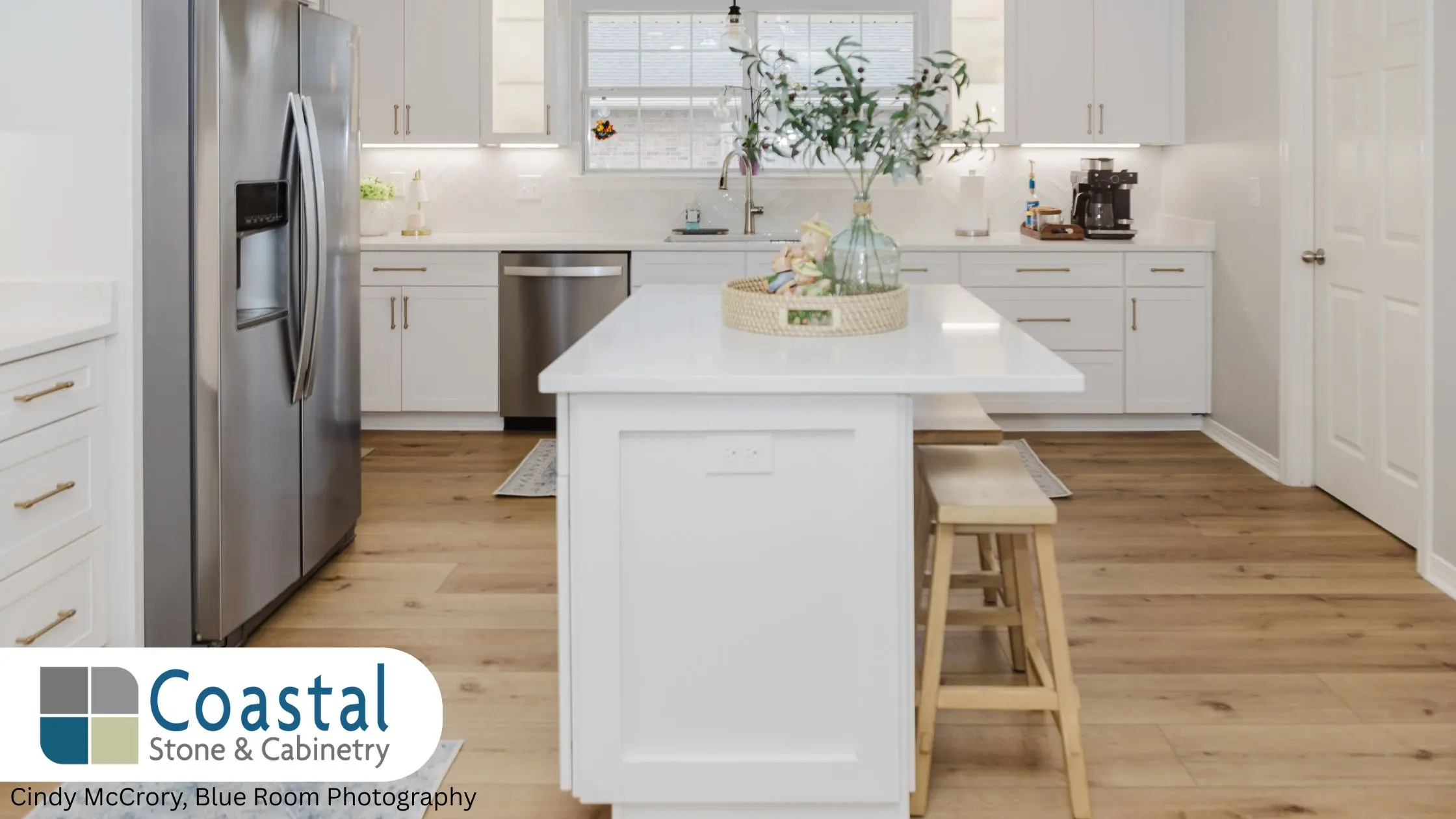
With white or very light cabinets, virtually any flooring tone works because the lightness of the cabinets provides natural contrast against most flooring options. Light floors with white cabinets create a fresh, airy look. Medium floors with white cabinets create a clean, classic combination. Dark floors with white cabinets create a high-contrast, dramatic result. The risk with very light cabinets is less about contrast and more about the relationship between the flooring and the countertop, which becomes the bridge element between the two.
With medium-toned cabinets, which include most natural wood finishes, warm grays and classic shaker styles in mid-range colors, the flooring selection becomes more nuanced. A floor that is too close in tone to the cabinet can make the kitchen feel monochromatic and flat. Going either lighter or darker in the flooring relative to the cabinet creates the visual separation that lets both elements be appreciated individually.
With dark cabinets, lighter flooring options create the contrast that prevents the kitchen from feeling heavy or enclosed, particularly in kitchens where natural light is limited. Dark cabinets paired with dark floors can work beautifully in a kitchen with generous natural light and high ceilings, but requires more careful management in a compact kitchen where the effect can feel oppressive.
Step Four: Match Wood Grain Direction and Scale
For homeowners choosing an engineered wood or LVP floor with a visible wood grain pattern, the scale and character of the grain relative to the cabinet door style is worth considering. A heavily grained, rustic floor with pronounced knots and strong color variation reads as casual and organic. Paired with a simple shaker cabinet, it creates a warm, relaxed kitchen that feels approachable and inviting. Paired with a sleek, contemporary cabinet with minimal detailing, the rustic floor and refined cabinet pull in opposite design directions and the tension between them can feel unresolved.
Conversely, a fine-grained, more uniform floor with minimal variation reads as cleaner and more refined. It pairs naturally with both contemporary and transitional cabinet styles and does not compete with more decorative cabinet door profiles the way a heavily grained floor might.
Our article for choosing the right flooring for every room goes deeper on how grain character and room function interact, which is a useful complement to this coordination checklist.
Step Five: Consider the Countertop as the Mediating Element
In a kitchen where the floor and the cabinets are making strong individual statements, the countertop often functions as the mediating element that bridges the two and brings the overall composition into balance. Understanding this role helps homeowners use the countertop selection strategically rather than treating it as an independent decision that happens to be made at the same time.
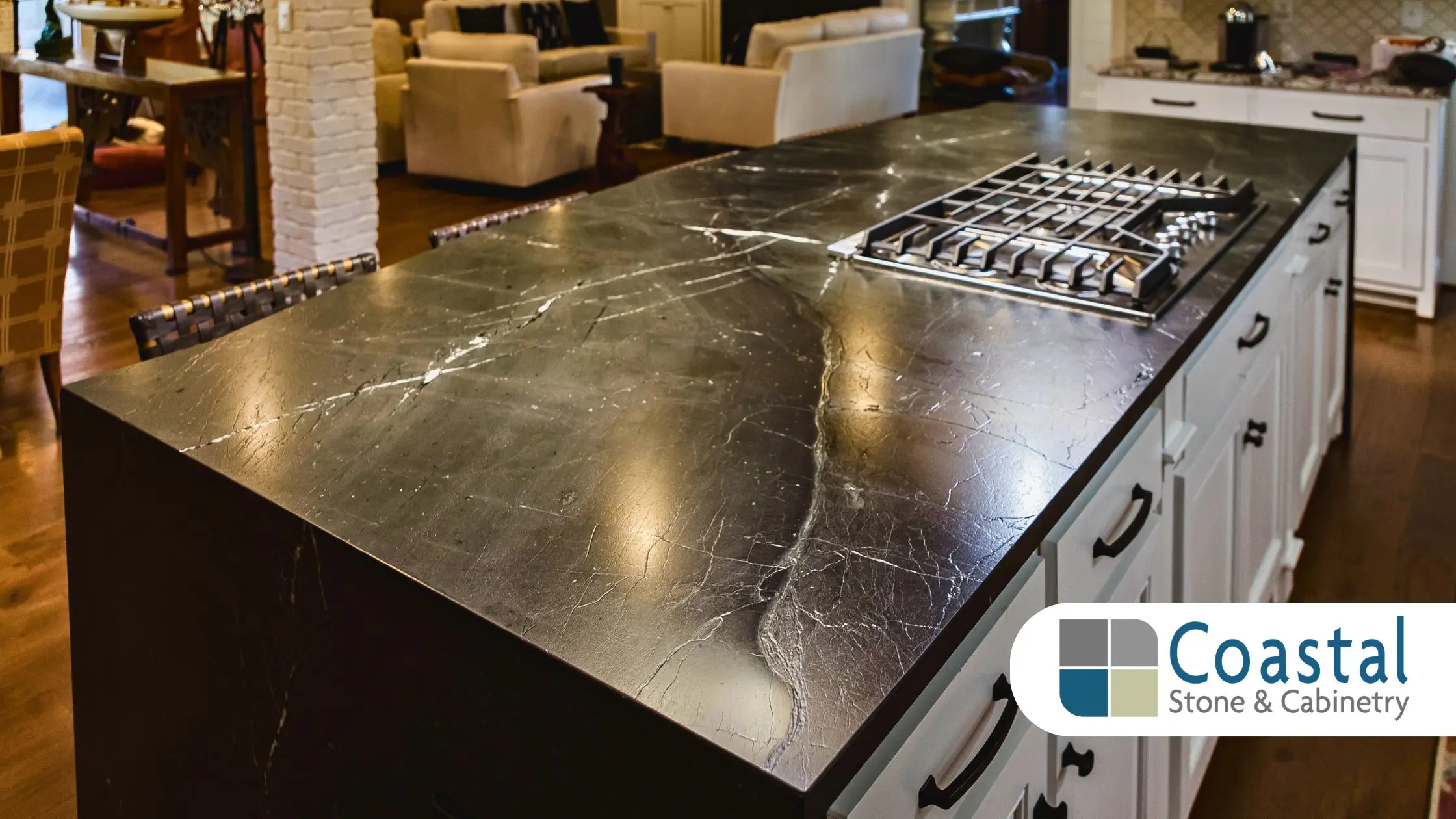
A warm-veined stone countertop can bridge a cool-toned floor and warm-toned cabinets by carrying elements of both into a single surface. A neutral quartz countertop lets the floor and cabinets do the design work while providing a clean, unobtrusive surface in between. A dramatic dark countertop with bold veining can anchor a lighter palette of floors and cabinets and give the kitchen a visual focal point that makes the overall design feel more resolved.
We offer a full range of kitchen countertops including granite, quartz, marble and quartzite, and the ability to evaluate countertop, cabinet and flooring options together in the showroom is one of the most valuable aspects of working with a supplier who carries all three product categories.
Step Six: Bring Real Samples Into the Actual Space
Every professional designer will tell you the same thing: samples look different in the showroom than they do in your home, and they look different at different times of day, under different lighting conditions and next to the other fixed elements in your kitchen. The only way to make a confident final decision is to bring actual samples of your top flooring and cabinet candidates into the space and evaluate them together in real conditions.
Most homeowners skip this step because it requires extra effort, and too many regret it at some point after installation when they notice something about the combination that the showroom visit did not reveal. The investment of time required to bring samples home and live with them for a day or two before committing to an order is modest relative to the size of the renovation investment and the years you will spend looking at the result.
For engineered wood and LVP flooring samples, evaluating a sample that is large enough to give a genuine sense of the floor’s character across multiple planks is important, since a single plank sample does not always represent the variation that will be present across a fully installed floor. We can provide flooring samples to take home as part of the selection process.
Step Seven: Confirm the Finish Level Compatibility
The finish level of the flooring, meaning whether it has a high gloss, satin, matte or wire-brushed surface, should be compatible with the overall finish direction of the cabinet and hardware selections. A high-gloss floor paired with matte-finish cabinets creates a finish clash that reads as inconsistent rather than intentional. A wire-brushed or matte floor paired with highly polished hardware can work but requires the contrast to be clearly intentional rather than accidental.
As a general rule, finish levels in a kitchen renovation read most cohesively when they are in the same family across the major surfaces. A consistently matte or satin approach creates a calm, unified result. A consistently glossy approach creates a polished, high-energy result. Mixing finish levels intentionally, for example a matte floor with a polished stone countertop, can work beautifully when the contrast is understood as a deliberate design choice.
Step Eight: Think About the Long View
Flooring and cabinets are long-term investments that most homeowners live with for a decade or more. Choosing a combination that feels genuinely right for the home, the family and the way the kitchen is used, rather than one that simply reflects what is trending at the moment of the renovation, produces a result that feels good not just at installation but five and ten years later.
This does not mean ignoring trends entirely. Trends exist for a reason, and the best of them reflect genuine shifts in taste and values that are worth taking seriously. But the best kitchen renovation decisions are rooted in a clear understanding of what works for your specific home, your specific lifestyle and your specific aesthetic rather than in a desire to replicate something seen on social media.
Our design associates work with homeowners throughout Daphne, Spanish Fort, Gulf Shores, Foley and Orange Beach to bring this kind of long-view perspective to kitchen renovation decisions, helping homeowners make choices they will be genuinely happy with rather than ones that look right today and feel dated tomorrow.
Ready to start coordinating your kitchen flooring and cabinets? Contact Us at 251-929-3475 to schedule a showroom appointment and work through these decisions with an experienced design associate.
Frequently Asked Questions
Should my kitchen floor be lighter or darker than my cabinets?
There is no single right answer, but the most important principle is that the floor and cabinets should have enough visual difference between them to read as distinct elements rather than blending together. With light or white cabinets, almost any floor tone works because the lightness of the cabinets provides natural contrast. With medium-toned or wood-finish cabinets, going either lighter or darker in the flooring creates the visual separation that lets both elements be appreciated. With dark cabinets, lighter flooring generally prevents the kitchen from feeling heavy, particularly in kitchens with limited natural light. Bringing samples into your actual space and evaluating them in real lighting conditions is the most reliable way to confirm which direction works best for your specific kitchen.
What is the best hardwood alternative flooring for a kitchen in Baldwin County?
Luxury vinyl plank (LVP) is consistently one of the strongest performing flooring options for Baldwin County kitchens because it is waterproof, dimensionally stable in the Gulf Coast’s humid conditions and highly resistant to the scratching and abrasion that kitchen foot traffic produces. Engineered wood is a strong choice for homeowners who want genuine wood character, though it requires more attention to moisture management than LVP. We offer both and they can be evaluated in the showroom alongside cabinet options for coordination purposes.
How do undertones affect the way flooring and cabinets look together?
Undertone is the warm, cool or neutral bias present in every flooring and cabinet product, and it is the hidden variable that causes more kitchen coordination failures than any other single factor. Products with conflicting undertones, such as a floor with warm yellow undertones paired with cabinets with cool gray undertones, can clash in a way that neither product would if paired with something that shares its undertone family. Evaluating flooring and cabinet samples together in the actual space is the most reliable way to identify undertone conflicts before committing to an order.
Can I use LVP flooring with wood-tone kitchen cabinets without them looking too similar?
Yes, as long as you choose an LVP product that has enough visual difference from the cabinet finish to create clear contrast. The key is to avoid selecting an LVP that is so close in tone and grain character to the cabinet that the two blend together visually. Going lighter or darker in the LVP relative to the cabinet, or choosing an LVP with a different grain scale or finish level, creates the separation that lets both elements be appreciated as distinct parts of the design. Bringing LVP samples and cabinet samples together into your kitchen to evaluate under real lighting conditions is the most reliable way to confirm the combination works before committing.
Does Coastal Stone & Cabinetry carry both flooring and cabinets so I can evaluate them together?
Yes. We carry flooring including engineered wood and luxury vinyl plank as well as kitchen cabinets, countertops and backsplash tile, which means designers and homeowners can evaluate all of these elements together in a single showroom visit rather than coordinating between multiple vendors. This integrated approach to selection is one of the most effective ways to ensure that the flooring, cabinets and countertop choices in a kitchen renovation work together as a cohesive design rather than as independent decisions that have to be reconciled after the fact. Schedule a showroom appointment at 251-929-3475 to start the coordination process.